







Black Paracord 550 Type III
£0.47


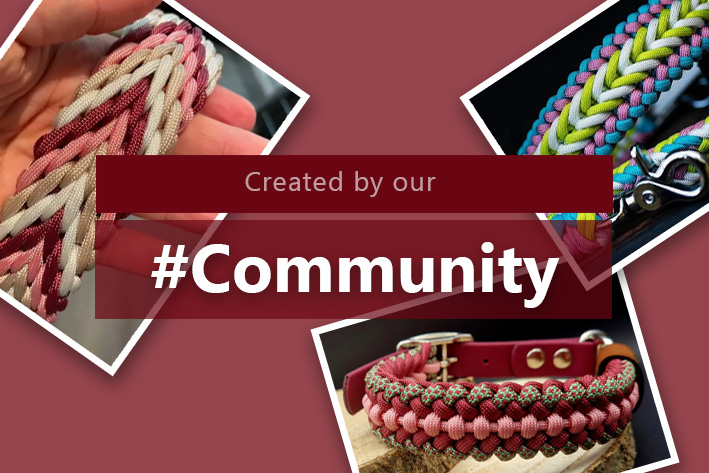


Looking to buy Paracord? Paracord is available in all sorts of thicknesses, colours and patterns. The various thicknesses are often referred to as "Type" or with the corresponding breaking force. For example, the most commonly used "Paracord Type III" is also referred to as "550 Paracord" because it has a breaking force of 550 lbs. (249 kg). In addition to Type III, Type II and Type I are also widely used for more elegant knotting and 'Micro' and 'Nano' are often used as accessory cord.
Because of the popularity of paracord there are many variants available. The majority of paracord users prefer nylon. Nylon feels more natural than the more plastic polyester. Nylon paracord is also more elastic, which is experienced as pleasant by knotters.
 Package Deals
 Paracord Type III
 Paracord Type II
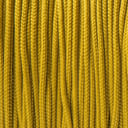 Paracord Type I
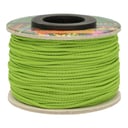 Paracord Micro Cord
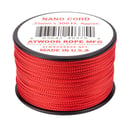 Paracord Nano
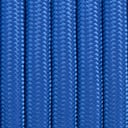 Paracord Max - 6mm
 Survival / Bushcraft Rope
 More Paracord Categories


The right paracord depends on two things: how much load it needs to carry, and how fine or bulky you want the finished project to look. As a starting point, Type III 550 covers most general use, Micro and Nano suit fine jewellery and bracelets, and Type IV 750 or Mil-Spec are for genuine load-bearing or military-grade requirements. Use the table below to compare diameter and breaking strength at a glance. For a full explanation of what paracord is, how it's made and what Mil-Spec means, see our guide What is Paracord.
| Type | Diameter | Breaking strength | Best for |
|---|---|---|---|
| Type III (550) | 3.8 mm | 249 kg | Dog leads, survival, general use |
| Type II (425) | 3 mm | 192 kg | Lanyards, lighter load applications |
| Type I (100) | 1.9 mm | 45 kg | Thin bracelets, decorative projects |
| Micro (1.2–1.5 mm) | 1.2–1.5 mm | 35–40 kg | Bracelets, keychains, fine knotwork |
| Nano | 0.75 mm | 17 kg | Jewellery, micro knotwork |
| Type IV (750) | 4.2 mm | 340 kg | Heavy-duty outdoor, horse halters |
| Mil-Spec | 1.8–3.8 mm | 43–250 kg | Military-grade, MIL-C-5040H certified |
Type III 550 is the most versatile option and the right choice for most projects: dog leads, survival bracelets, hammock lashings and general outdoor use. For bracelets and keychains where you want a slimmer result, Micro or Type I cord gives a neater finish. For fine jewellery work or detailed knotwork, Nano cord at 0.75 mm is the thinnest option we stock. Heavy-duty applications like horse halters or load-bearing lashings call for Type IV 750 at 340 kg breaking strength.
As a rule of thumb: for a cobra bracelet allow around one metre of paracord per centimetre of bracelet length, so roughly 2 to 2.5 metres for an average wrist. For a dog lead of 1.5 metres, allow at least 10 metres of Type III. Not sure? Use our Paracord Matchmaker to calculate the exact amount for your project and find matching colours.
Our bestselling paracord, built with a 32-strand woven sheath around 7 inner strands for a smooth, flexible finish. Available in over 200 colours and patterns, from solid shades to diamond, helix and reflectable weaves. The most forgiving cord to knot with, which is why it's the default choice for first-time makers.
A slimmer 16-strand construction that keeps the classic paracord look at a fraction of the bulk. Comes in 1.2, 1.4 and 1.5 mm diameters, both offered in the same colour range as our Type III cord so you can match a fine accessory to a larger project.
Our finest cord, spun rather than sheath-and-core like the thicker types. At 0.75 mm it behaves more like a strong thread than a rope, which is why it's favoured for delicate jewellery work where a bulkier cord would overwhelm the design.
Steps up to an 11-strand core inside the same woven sheath construction, giving a noticeably stiffer handle than Type III. At 4.2 mm diameter and 340 kg breaking strength, the extra strand count is what pushes the load rating up rather than a thicker sheath alone.
Manufactured to the exact MIL-C-5040H spec rather than a commercial equivalent, meaning tighter tolerances on strand count and sheath weave. Available in Type I (1.8 mm, 43 kg) and Type III (3.8 mm, 250 kg), restricted to authentic military colourways like olive drab, coyote brown and black rather than our full civilian colour range.
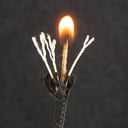
Goes beyond standard construction by building extra function into the cord itself. Fish and Fire paracord hides a length of fishing line and a fire starter strand inside the sheath, so the cord doubles as a compact survival kit rather than just cordage.
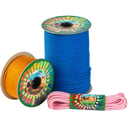
Pre-bundled sets rather than single-colour spools, either a curated multi-colour assortment or one colour in bulk from 10 to 300 metres. Priced per metre lower than buying the same lengths individually.
Our guide What is Paracord covers everything from the history of paracord and how it's constructed, to Mil-Spec standards and the difference between nylon and polyester cord. Use the Paracord Matchmaker to find colours and calculate how much you need for your project.
The main difference is diameter and breaking strength. Type III 550 is 3.8 mm with 249 kg breaking strength and is the most common choice. Type IV 750 is 4.2 mm with 340 kg and is used for heavier applications. Micro cord runs from 1.2 to 1.5 mm and Nano is 0.75 mm, both suited to jewellery and fine knotwork.
Type III 550 paracord is the standard choice for dog leads, with 249 kg breaking strength and 3.8 mm diameter. Pair it with a snap hook rated to at least your dog's weight and a triglide for length adjustment.
For a cobra bracelet, allow roughly one metre of paracord per centimetre of bracelet length (see the calculation above). The type you choose changes that math slightly: Micro cord's slimmer profile means each knot uses marginally less material than Type III, so a Micro bracelet can come in a touch under the standard estimate. For an exact figure based on your wrist size and chosen cord, use our Paracord Matchmaker.
Traditional Mil-Spec paracord is nylon, which is slightly stretchier and more UV-resistant when wet. We also stock polyester paracord, which has lower stretch and better UV resistance when dry. See our guide What is Paracord for a full comparison.
Yes, all paracord at Paracord.eu is available by the metre or on spools from 10 to 300 metres. Select your preferred length at the product page.